Can legislative speech unveil conflict between coalition parties? An empirical illustration based on two examples in the German Bundestag
Abstract
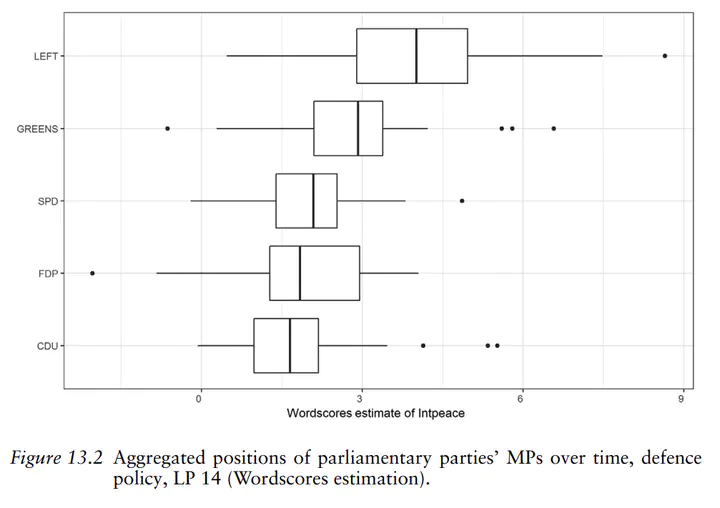
Stark between-party conflict in coalition governments can lead to legislative gridlock, cabinet instability and early dissolution of parliament. This chapter provides a text-as-data approach to capturing legislative conflict between coalition parties dynamically across the electoral term. We employ topic modelling and the Wordscores scaling method to estimate disagreement between government parties in legislative debates over time in Germany. Two German coalition governments were faced with votes of confidence in 2001 and 2005, specifically Chancellor Schröder’s first and second cabinets, which were composed of Social Democrats and Greens. We assume two specific policy areas (‘defence’ and ‘labour market/social policy’) to be substantial in describing the main conflict lines that led to life-threatening government crises. Our findings suggest that analysing speech across the electoral term contributes to the understanding of inter-party conflict dynamics. The integration of such measures into the empirical modelling of coalition governance or cabinet stability provides fruitful avenues for future research.